Top Signs You Need Garage Door Service – Don’t Ignore These
A door that takes two seconds longer to open than it used to isn’t a quirk. It’s a spring that’s lost measurable tension, and by the time it feels “really slow,” you’re usually one cold morning away from a complete break. Most garage door warning signs are easy to rationalize away, so this piece explains the mechanical reason each symptom gets worse over time. If you’d rather not climb a ladder with a flashlight, call (855) 337-1961 and we’ll take a look.
Why Garage Door Problems Get Worse Instead of Better
Garage doors don’t fail like lightbulbs, which work one day and quit the next with no warning. They fail like a worn engine mount: a little extra vibration today, a rattle next month, a metal-on-metal complaint by spring. Every symptom you notice is a snapshot of a mechanical process already underway, and the parts involved are generally cheap and easy to replace early but expensive and awkward once they take siblings with them.
The counterweight system at the heart of any door is a balance of tension. Springs hold a specific amount of stored energy to make a heavy panel feel light in your hand. Openers push and pull, but they don’t really lift a door; they guide a door the springs already lifted. Rollers ride in tracks. Cables tie springs to the bottom corners. When any one of these falls out of spec, the others pick up the strain, which is why a small problem in Commerce City rarely stays small.
Here’s the part most guides skip: doors that have already failed and been manually forced or shimmied open often return to looking and feeling fine. The parts are already outside their intended tolerances at that point, so the next failure comes without any additional warning. If you’ve ever wedged a door open with your shoulder after an opener quit, you’re in the “working fine” trap right now. The door is waiting, not cooperating.
Below, we break down the specific symptoms worth acting on, what’s happening inside the system when you see them, and roughly what your door will look like in 30, 60, and 90 days if nobody intervenes.
Symptom 1: The Door Feels Slower or Heavier Than It Used to
A door that drags on the opener or takes a visible extra beat to rise is a tension problem first and a motor problem second. Springs relax as they cycle over thousands of openings, and the stored energy that makes a panel feel light in your hand quietly diminishes. The opener starts carrying weight it was never designed to carry. In 30 days, you’ll feel it in the door’s hesitation. By 60, the opener motor hums louder or the emergency release becomes tempting. By 90, you’re usually looking at a stretched or fatigued spring and a motor working twice as hard.
Notice the “slower” and “heavier” symptoms happening together. Those two are one story, not two. When the opener fights a compromised spring, the strain transfers to the drive gear, the trolley, and the shaft. A Craftsman or Raynor opener that’s served quietly for years can develop a grinding complaint not because the opener failed but because the door it’s lifting changed.
There’s a reason garage door specialists ask you to test the door by hand with the opener disconnected and the door fully closed. Lift it slowly to about halfway and let go. A properly balanced door should stay roughly where you leave it. A door that drops or rockets up is telling you the balance is gone, and you should not force it back down. Call us for that test if you’re unsure. Reconnecting a weight-bearing door to a moving opener after a manual test is how damage gets compounded.
Symptom 2: The Door Moves Unevenly Side to Side
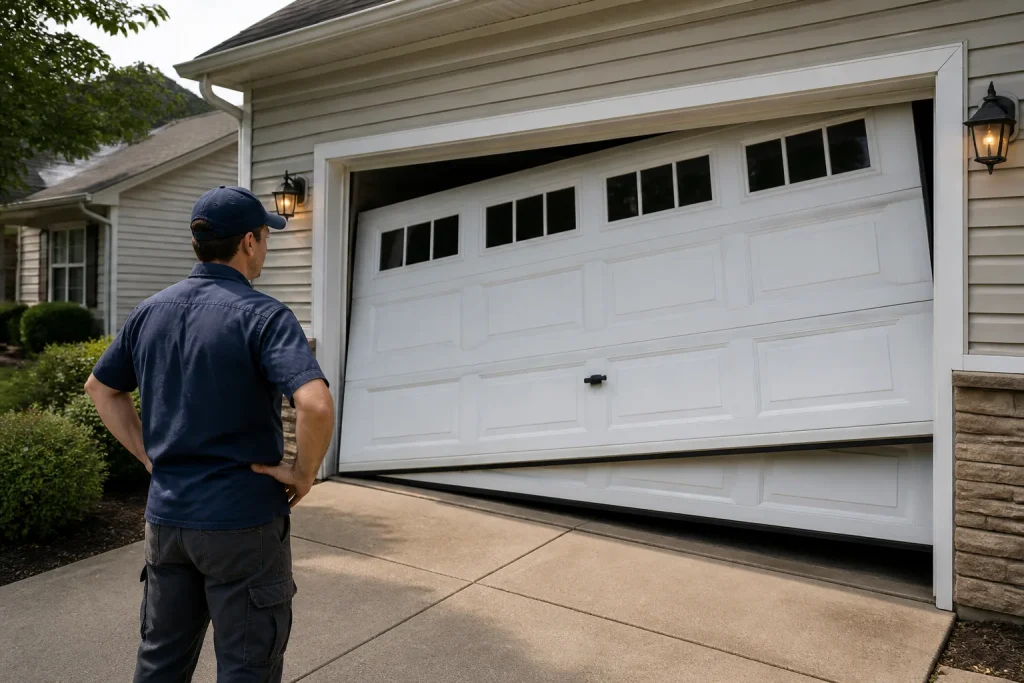
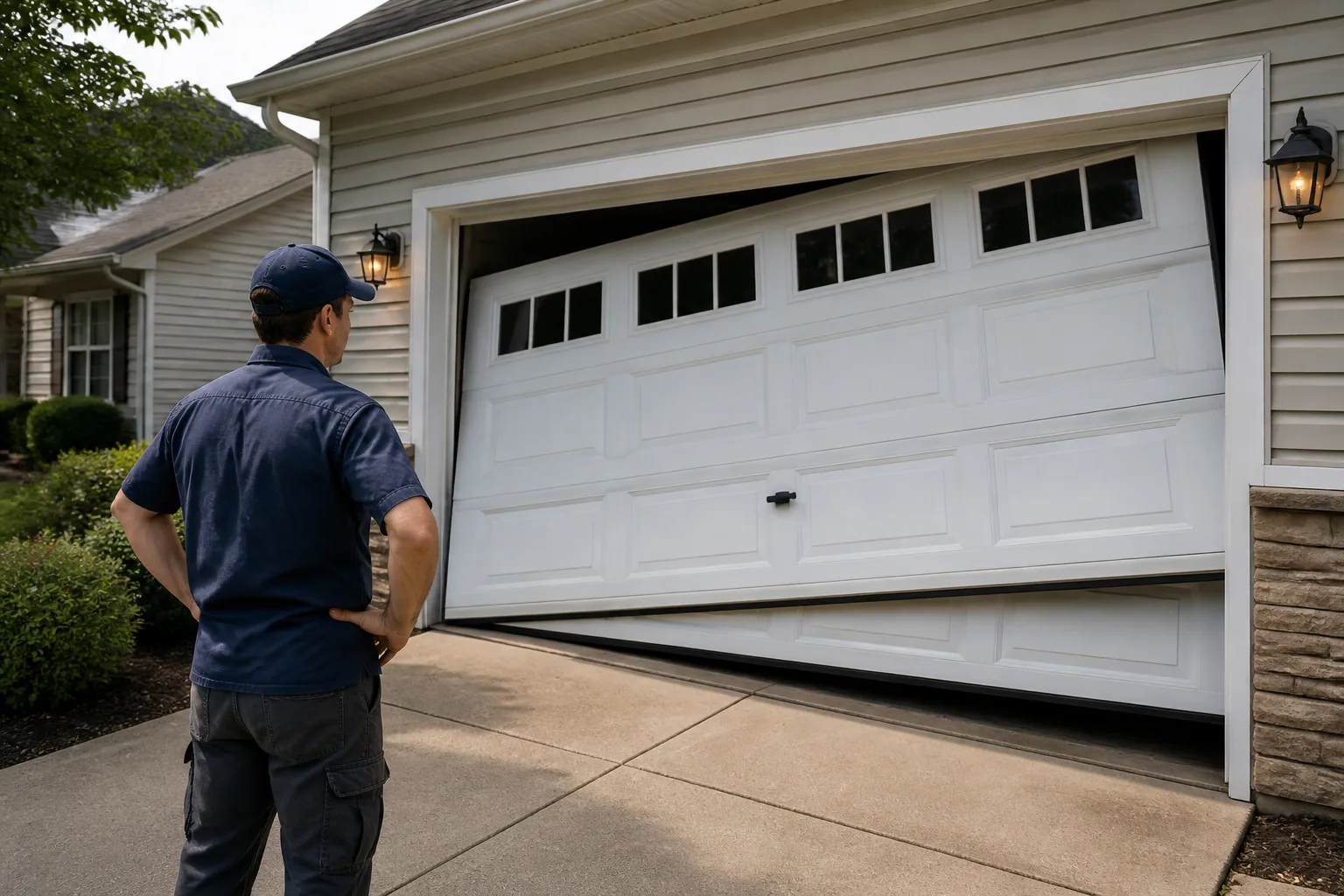
Asymmetric movement is almost always a balance problem, not a track problem. That distinction determines how fast you need to act. When one side of the door climbs higher than the other, or a visible gap opens at one corner, the culprit is usually a cable that’s stretching unevenly, a spring with a different tension than its partner, or a drum that’s not take-up cable on both sides at the same rate. The door is no longer square, and once it’s out of square, every roller and hinge is bearing uneven load.
Tracks get blamed because they’re the visible thing, but a bent track on a level door drags politely and usually announces itself with noise. Unevenness without noise points to the cable-spring system, and that’s the urgent category. Here’s the progression:
- Week 1 – 2: One corner hangs slightly. The opener may still handle it. Cosmetic gap at the bottom or top.
- Week 3 – 4: A roller pops out of the track, the door binds, and the opener starts laboring. A C-channel or jamb complaint becomes visible.
- Week 5 – 6: A cable can slip off the drum entirely, which lets the door fall. This is when a level problem turns into a weight problem and becomes dangerous to touch.
Cables run under real tension. If you see a cable slack, frayed, or off its drum, do not try to re-spool it yourself. A snap-back from a loaded cable is the kind of injury that sends people to the emergency room, and it happens fast. We handle that side of the repair as a spring-specialty job because the cable is never really the problem in isolation. In Commerce City, this is one of the calls we’d rather hear about on day one than day twenty.
Symptom 3: The Sounds Tell You What’s Wrong (and How Urgent It Is)
Sound is diagnostic data. A garage door in good health makes the same soft rumble every time. A change in that sound is a specific part telling you it’s changing condition. Most homeowners hear “noise” and picture lubrication. In our experience, each sound signals a specific fix:
- Grinding or squealing: Dry rollers, worn hinges, or a dry torsion shaft. This is the mildest failure on the list. Grease buys time, but the grinding usually maps to a roller or hinge at end of life. Replace them and the noise goes away.
- A short, sharp pop: Spring coil fatigue. The spring is starting to tire at a specific point in its wind. That pop is the coil shifting. A broken spring usually announces itself with a bang, so a pop means you’re on the ramp.
- A scrape or drag: The door panel is contacting the track. That’s alignment, and a misaligned track will wear the panel’s edges or start throwing rollers.
- A loud bang from the spring area: A spring snapped. The door becomes extremely heavy and the opener is no longer trustworthy. This is a stop-what-you’re-doing call.
We can tell a lot from a description on the phone, but not everything. If you’re hearing a bang and the door won’t move, disconnect the opener and leave the door down until a technician sees it. Do not pull on it from the outside. High-tension springs are not a DIY repair, and the injury profile is why we treat them as a dedicated specialty rather than a general handyman job.
Symptom 4: The Opener Forgets, Blinks, or Won’t Respond
An opener that ignores the remote, buzzes and reverses, or flashes a code isn’t always an opener failure. On modern units like LiftMaster and Chamberlain myQ systems, most “dead” openers trace back to one of three things: power or logic, the safety sensors at the bottom of the tracks, or the door’s own resistance overloading the motor. If the door has grown heavy, the opener’s safety reverse trips on every descent. That’s a door problem showing up in the opener, and a new opener alone won’t fix it.
Older mechanical units tell a different story. A Genie or Craftsman opener that’s run hard for years starts to lose the drive gear, the limit switch loses calibration, and the trolley grinds. Sometimes the fix is an adjustment and a new gear. Sometimes the fix is that the door should be replaced and the opener needs replacing with it. Both are readings we make on site, not guesses.
A quick safety check you can do right now: close the door and wave a broomstick under the beam at the bottom. If the door stops and reverses, the sensors are reading fine. If it ignores the obstruction, stop using the opener and call us. A shop-vac or a neighbor’s kid under a door that won’t reverse is a call we don’t want. For opener-specific questions, our garage door opener repair page walks through the common platforms.
Symptom 5: Visible Wear Worth Acting On Early
You don’t need a technician’s eye to find the wear signs; you just need to know where to look. Rollers should spin freely and look intact, not flat-spotted or cracked. The hinges at the door joints should be tight, not loose or chewed through. The bottom seal should be touching the floor evenly, not curled or torn. Cables should be straight and tight, not kinked or frayed. The torsion shaft hardware should be tight at both ends, because a loose set screw lets the shaft walk and throw the whole system out of balance.
- Flat-spotted rollers: Replace them before they bind and force the door to skip its track.
- Torn bottom seal: A small gap invites weather and pests in, and the seal is cheap to replace while the panel is intact.
- Loose hinge screws: Tighten them early. A stripped hinge is a panel repair, and panel repairs are more expensive than hinge replacements.
- Any visible cable damage: Do not touch it. This is a stop-and-call.
The cleaner your hardware looks, the longer the door holds. A little preventive attention here in Commerce City goes a long way, because the seasonal swings work against the hardware all year.
The 30, 60, 90-Day Rule: What Happens If You Wait
Here’s what the garage door industry rarely says plainly: almost every worn component has a “still working” phase of about 30 days where the door runs slightly off but doesn’t fail. That window is the cheapest time to fix it. Left alone, a worn part spreads wear to the rest of the system, and the repair grows with the parts involved.
- 30 days: A symptom appears; the door still runs, but the symptom repeats. An adjustment or a single part swap usually closes it.
- 60 days: The symptom is now part of the daily routine. The strain has spread to the opener, the tracks, or the drum. Repair costs reflect two or three components, not one.
- 90 days: The part fails completely. If it’s a spring, you may be dealing with a door that won’t open, a car trapped in the garage, and an emergency call. That full-service arc matters once a door fails, and it’s why we keep spring repair, opener service, and garage door repair available under one call.
The takeaway: the symptom is the message, not the problem. Fixing the message early is the cheapest path to a door that behaves.
Proactive Timing for Commerce City Weather
Temperature drives the whole spring system. Metal contracts and expands with each change, and the tight seasonal swings around Commerce City put more stress on a door than most homeowners realize. Cold mornings are when tired springs tend to let go, because the metal goes rigid and wants to keep its stored energy where it is. Peak heat is when the door runs heavier than it should because the parts expand.
Here’s a practical check calendar, not to comply with anything but to save money:
- Late fall, before the first hard freeze: Have the balance tested and the hardware inspected. A spring that’s lost a little tension is quieter now than it will be at 7 AM on a cold day.
- Early spring: Check the seals and the bottom weatherstrip after winter drives the humidity back up. Look for rust on the tracks and hinges.
- Mid-summer: A quick test for any change in the usual sounds under heat load. This is when greasy hardware complains.
- Any time after an event: If the door has been forced, bumped, or run on a failed part even once, have it inspected before trusting it again.
Book a balance test into your routine and most of the emergency calls never happen. If you’ve been putting off a check, you’re not alone. Human beings are good at ignoring rhythmic sounds until the rhythm stops. We’re happy to be the call that gets your routine back.
When to Call a Pro
Stop the DIY and call a pro when any of these are true: a spring makes a sudden bang, a cable looks slack or frayed, the door hangs off level, the opener keeps reversing on its own, or the door won’t stay where you leave it when raised by hand. You should not test, re-spool, or force any of those conditions. High-tension springs and loaded cables are the parts of a garage door that can hurt you, and a trained technician’s approach is a matter of physics, not politeness.
For everything else, we’re glad to be the call. Commerce City Garage Door Repair Co works on LiftMaster, Chamberlain, Genie and Craftsman openers along with the Clopay, Amarr, Wayne Dalton and Raynor doors we routinely see. Whether your door needs a new opener, a spring, or a full-upgrade replacement, the same team that repairs your current door can replace it when it reaches end of life. Our technicians have up to 15 years of experience, and we can help you understand which of the signs above you’re looking at so you can decide with facts, not fear. When a new door starts to look like the better long-term move, our garage door installation page covers what that involves.
Related services in Commerce City: garage door repair, opener repair, spring service, and new door installation.
Meet Commerce City Garage Door Repair Co – the team behind these guides and the people who show up for the problem, big or small.
The Bottom Line
The top signs you need garage door service are a door that feels heavier or slower, a door that moves unevenly side to side, a change in the usual sounds, an opener that fails to respond or reverses on its own, and visible wear on rollers and cables. Each of these is a mechanical process already in progress, not a random fault. The cheapest time to fix any of them is the first 30 days, before the wear spreads to nearby parts. Ignore a symptom and the parts count climbs; act on it early and the fix is usually one component.
If you’re in Commerce City and need help, Commerce City Garage Door Repair Co offers free estimates. Call (855) 337-1961 and we’ll tell you what we see, what it involves, and what it costs before any work starts.
Frequently Asked Questions
The most reliable early sign is a door that feels heavier or takes noticeably longer to open than it used to. That usually means the springs have lost tension. Other first signs are one side of the door rising higher than the other, a new grinding or scraping sound, an opener that reverses on its own, and visible wear on rollers, hinges, or the bottom seal. Any of these is a signal to get a professional look. Call (855) 337-1961 for a free estimate.
No. With a broken spring, the door is far heavier than the opener was designed to lift, and the opener’s motor and gear train take the full load. The door may rise a foot or less and then hold. Pulling on it by hand is also unsafe, because a spring and cable under load can snap back. Stop using the door and call (855) 337-1961. We treat springs as a dedicated specialty because they demand trained handling.
Your price is quoted and agreed before any work starts. The written estimate you approve is the price for the job described. If a technician finds something additional once the door is inspected, such as a worn hinge or a bent track, that’s presented as a separate line so you can decide. Deliberate add-ons after work begins are not how we operate. Call (855) 337-1961 for an exact quote.
Yes, we offer same-day service for urgent situations like a door that won’t open with a car trapped inside or a spring that has snapped. Call (855) 337-1961 and tell us what you’re seeing. If your door has failed but the car isn’t trapped, we’d still rather hear about it today than wait for it to get worse. A fast response on a genuinely urgent problem is one of the reasons we offer emergency service.
Written by the team at Commerce City Garage Door Repair Co.
Need Garage Door Help?
Call Commerce City Garage Door Repair Co - the local pro we connect you with is licensed and insured, here with fast after-hours help in Commerce City.
(855) 337-1961